
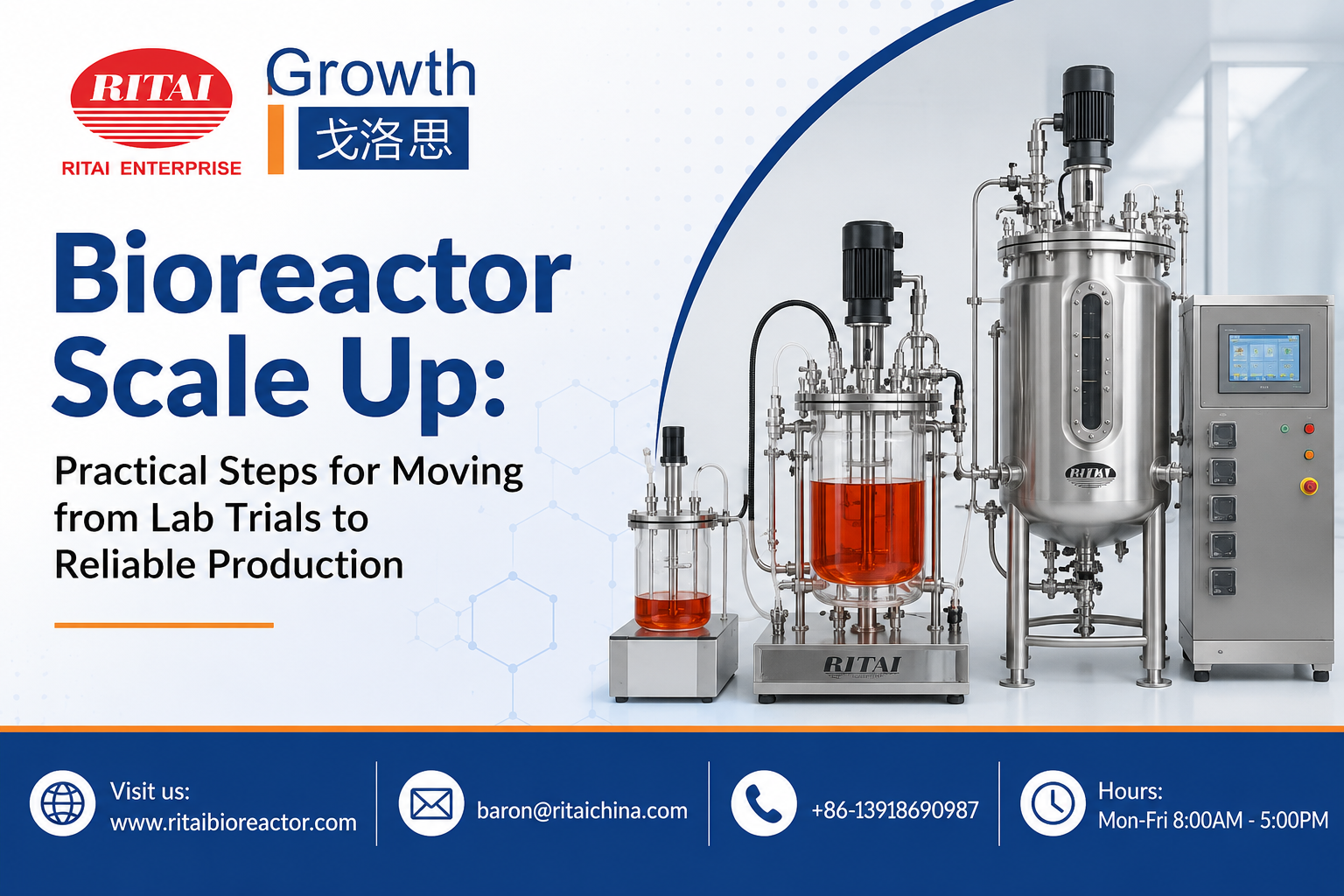
Bioreactor Scale Up is one of the most important stages in bioprocess development. A formula may work well in a small lab vessel, but that does not mean it will behave the same way in a larger system. Mixing time, oxygen transfer, temperature control, foam formation, shear stress, and contamination risk can all change as the working volume increases.
This is why companies, universities, and research teams treat Bioreactor Scale Up as a planned technical process, not just a matter of buying a bigger tank. A successful scale-up keeps the biology stable while improving production volume, consistency, and process control. Brands such as Ritai Bioreactor support this work by offering systems that help researchers move from early-stage testing to pilot and production-ready processes.
Why Bioreactor Scale Up Matters
In biotechnology, small mistakes can become expensive at larger volumes. A cell culture, bacteria fermentation, enzyme process, or vaccine-related workflow may show strong results in a Benchtop Bioreactor, but performance may drop when transferred to a larger vessel. This happens because microorganisms and cells respond strongly to their environment.
For example, a bacterial fermentation may need fast oxygen transfer. In a small vessel, oxygen can be supplied easily. In a larger tank, poor mixing may create low-oxygen zones. This can reduce yield, slow growth, or change product quality. In another case, mammalian cells may be sensitive to shear force. If agitation is increased too aggressively during Bioreactor Scale Up, cell viability may fall.
A careful Bioreactor Scale Up strategy helps reduce these risks before commercial production begins.
Starting with a Benchtop Bioreactor
Most scale-up projects begin with a Benchtop Bioreactor because it gives researchers control over key process parameters. These systems are widely used for media screening, strain testing, cell growth studies, and early process optimization.
A Benchtop Bioreactor allows teams to monitor pH, dissolved oxygen, temperature, agitation speed, gas flow, and foam control. These values create the foundation for larger-scale design. Instead of guessing, process engineers can use actual lab data to plan the next stage.
For example, if a fermentation process performs best at a specific dissolved oxygen level, the scale-up team must design the larger system to maintain similar oxygen transfer. This may involve impeller selection, airflow adjustment, sparging design, or pressure control.
Ritai Bioreactor provides Benchtop Bioreactor options for research and development teams that need stable performance, clean design, and practical process control.
Role of a Glass Bioreactor in Lab Development
A Glass Bioreactor is often used during laboratory research because it allows visual observation of the process. Researchers can watch foam levels, mixing behavior, color changes, cell suspension, and contamination signs more easily than in opaque vessels.
For early-stage work, a Glass Bioreactor is useful because it combines process control with visibility. It is commonly used in microbial fermentation, cell culture development, enzyme research, and academic training labs.
During Bioreactor Scale Up, data from a Glass Bioreactor can help identify process behavior before moving to stainless steel or pilot-scale systems. If foam forms quickly, if cells settle, or if mixing looks uneven, the team can fix these issues early.
A well-designed Glass Bioreactor from Ritai Bioreactor can support repeatable lab studies and give teams confidence before moving into higher-volume production.
Key Parameters in Bioreactor Scale Up
Bioreactor Scale Up depends on more than working volume. Engineers must compare several technical factors between small and large systems.
Oxygen transfer is one of the most important. Many microbial processes need high oxygen availability. If oxygen transfer is poor, growth and productivity can suffer.
Mixing time is another major factor. A larger bioreactor needs proper agitation to distribute nutrients, gases, and temperature evenly. Poor mixing can create zones where cells experience different conditions.
Shear stress also matters, especially for animal cells, stem cells, and fragile organisms. Too much mechanical force can damage cells.
Temperature control becomes harder as volume increases because larger batches generate and retain more heat. The cooling system must be strong enough to maintain stable conditions.
Cleaning and sterilization are also critical. A process that is easy to manage in a Benchtop Bioreactor may require advanced sterilization and clean-in-place systems at larger scale.
Common Mistakes During Bioreactor Scale Up
One common mistake is assuming that the same agitation speed will work at every scale. This is rarely true. RPM alone does not describe mixing efficiency. Engineers often need to consider tip speed, power input, oxygen transfer rate, and vessel geometry.
Another mistake is moving too quickly from lab scale to production scale. A pilot stage is often needed to reduce uncertainty. This step helps confirm whether the process behaves properly before large investment.
A third mistake is ignoring process data. Bioreactor Scale Up should be based on measured results, not assumptions. Data from a Benchtop Bioreactor or Glass Bioreactor can guide equipment design, control settings, and batch strategy.
How Ritai Bioreactor Supports Scale-Up Work
Ritai Bioreactor offers equipment solutions for different stages of bioprocess development. For research teams, a Benchtop Bioreactor or Glass Bioreactor can help build reliable process data. For pilot and production environments, larger systems can support higher working volumes and more advanced control.
The real value lies in matching the system to the process. A bacterial fermentation project, vaccine process, cell culture workflow, or enzyme production line may each need different vessel design, control options, and automation levels.
By choosing equipment that supports Bioreactor Scale Up from the beginning, teams can reduce trial-and-error, improve batch consistency, and shorten development time.
Final Thoughts
Bioreactor Scale Up is not just a technical upgrade. It is the bridge between lab success and real production. A strong scale-up plan protects product quality, improves yield, and reduces operational risk.
Starting with a reliable Benchtop Bioreactor, using a Glass Bioreactor for process observation, and working with experienced equipment providers such as Ritai Bioreactor can make the transition smoother.
For any biotech team planning fermentation, cell culture, vaccine research, or industrial bioprocessing, Bioreactor Scale Up should be handled with care, data, and practical engineering judgment.